

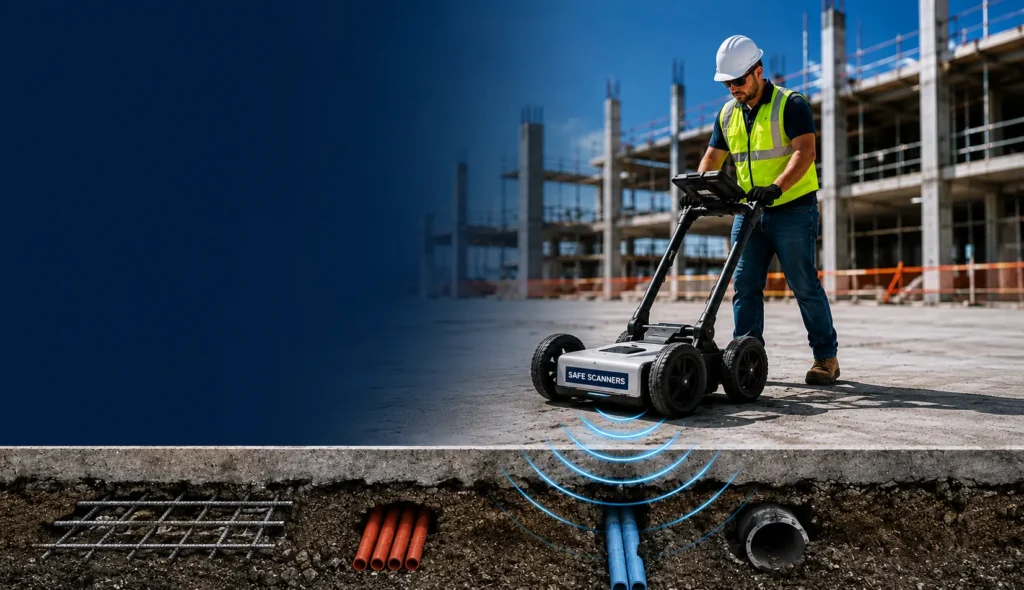
Florida’s construction boom is undeniable. From the towering high-rises of Miami to the sprawling residential developments in Central Florida, the state is constantly building, renovating, and expanding. But beneath the surface of this rapid growth lies a complex and often unpredictable subterranean landscape. Before a single trench is dug or a concrete slab is cored, understanding what lies beneath is not just a matter of efficiency—it is a critical component of construction safety. This is where the unseen advantage of GPR scanning comes into play.
At Safe Scanners, we understand that the foundation of any successful project in Florida is safety. Ground Penetrating Radar (GPR) has revolutionized how contractors, engineers, and project managers approach subsurface investigation, turning potential hazards into mapped, manageable data.
What is GPR Scanning?
Ground Penetrating Radar, or GPR scanning, is a non-destructive testing (NDT) method that uses high-frequency electromagnetic radio waves to image the subsurface. Think of it as an MRI for the ground or concrete. A GPR unit, typically pushed on a cart or used as a handheld device, emits radar pulses into the material being scanned. When these pulses encounter a change in material—such as a plastic PVC pipe, a metallic water main, a void, or a steel rebar—the signal reflects back to the receiver.
These reflections are instantly translated into a visual profile on a screen, allowing trained technicians to interpret the size, depth, and location of hidden objects. Unlike traditional X-ray methods, GPR emits no harmful radiation, requires access to only one side of a structure, and provides real-time data without the need to clear the job site.
The Unique Challenges of Florida Construction
Florida presents a unique set of challenges for construction professionals, making professional GPR services not just a luxury, but a necessity.
The Soil Diversity Factor
Florida’s geology is incredibly diverse. In Central Florida, contractors frequently encounter “sugar sand,” which is generally low in conductivity and allows radar waves to travel deeper, providing excellent GPR imaging conditions. However, move toward the northern parts of the state, and you will find clay-heavy soils. Clay is highly conductive and can rapidly absorb radar signals, limiting the depth of the scan. Furthermore, South Florida is built largely on oolite limestone, which presents its own set of density challenges.
The Threat of Karst Terrain and Sinkholes
Perhaps the most notorious subsurface hazard in Florida is its karst terrain. The state sits on a bedrock of porous limestone that slowly dissolves over time due to acidic groundwater. This process creates underground cavities and voids that can eventually collapse into sinkholes. Heavy construction equipment operating over an undetected void can trigger a catastrophic collapse. GPR scanning is highly effective at identifying these anomalies—showing up as hyperbolic reflections or disrupted stratigraphy on radargrams—allowing engineers to reinforce the ground before construction begins.
High Water Tables and Moisture
Florida’s frequent heavy downpours and naturally high water tables significantly impact subsurface work. Because water is highly conductive, saturated ground can cause radar signals to bounce off the surface or dissipate quickly. Professional GPR technicians know how to navigate these conditions, advising on the best times to scan and adjusting equipment frequencies to cut through the noise.
Revolutionizing Safety with Concrete Scanning
While locating underground utilities is crucial, concrete scanning is equally vital for structural safety during renovations and retrofits. Before cutting, coring, or drilling into an existing concrete slab, you must know what is embedded inside.
Protecting Post-Tension Cables
Many modern buildings in Florida utilize post-tensioned concrete. These slabs contain high-strength steel cables pulled to immense tension to support the structure’s weight. Accidentally severing a post-tension cable during a core drill is not just an expensive mistake; it is a lethal hazard. The cable can snap violently, bursting through the concrete and causing severe injury or structural failure. GPR concrete scanning pinpoints the exact location and depth of these cables, allowing workers to drill safely around them.
Avoiding Live Conduits
Electrical conduits are frequently embedded directly into concrete floors and walls. Striking a live high-voltage line can result in electrocution, fires, and massive power outages for the surrounding area. By utilizing GPR services, contractors can map out the intricate web of conduits, ensuring that saw blades and drill bits never make contact with live wires.
Preserving Structural Integrity
Every time you cut into reinforced concrete, you alter its load-bearing capacity. By mapping the rebar grid with GPR, structural engineers can determine the safest entry points for plumbing, HVAC, or electrical installations, ensuring the building remains structurally sound and up to code.
The Cost of Guesswork vs. The Value of Certainty
The Common Ground Alliance reports hundreds of thousands of utility damages across the U.S. annually. In Florida, where development is dense and infrastructure is constantly overlapping, the risk of a utility strike is exceptionally high.
When a contractor relies on outdated as-built drawings or simply guesses where utilities might be, they are gambling with their budget and their crew’s lives. A single utility strike can lead to:
- Severe Injuries or Fatalities: Especially in the case of gas lines or high-voltage cables.
- Project Shutdowns: Work stops immediately while emergency repairs are made.
- Massive Fines: OSHA violations and municipal fines for damaging public infrastructure.
- Reputational Damage: Delays and accidents erode client trust.
Investing in professional GPR services upfront is a fraction of the cost of repairing a severed fiber-optic cable or a ruptured water main. It transforms a blind excavation into a precise, data-driven operation.
Why Choose Safe Scanners in Florida?
At Safe Scanners, we don’t just own the equipment; we possess the localized expertise required to interpret the data accurately. Operating GPR technology is only half the battle; the true value lies in the analyst’s ability to differentiate between a tree root, a PVC pipe, and a structural rebar amidst the “noise” of Florida’s complex soils and dense concrete.
We partner with general contractors, engineers, and property managers across Florida to provide comprehensive subsurface mapping. Whether you are breaking ground on a new commercial development in Tampa, renovating a high-rise in Miami, or laying new utility lines in Orlando, our GPR scanning and concrete scanning services provide the unseen advantage you need to build with confidence.
Don’t let what you can’t see derail your project. Prioritize safety, protect your budget, and ensure compliance by making Safe Scanners your first call before the first cut. Contact us today to schedule your site evaluation and experience the peace of mind that comes with total subsurface clarity.